Showing posts with label spirit. Show all posts

Monday, February 11, 2008

French Grammar Ghosts

From my French textbook:

"Il y a is used to state that a person, place, or thing exists. It does not necessarily mean that the item in question can be seen from where you are standing:


Dans ma chambre il y a un lit, un bureau et des chaises.

In my room, there are a bed, a desk, and some chairs. (They exist.)"


When learning a new language, the mechanics of grammar and reference reveal themselves in interesting ways. Thinking back to things I've read and the way ideas are translated into my native tongue, it is enlightening to feel the nuances of poetic texts. The words that I read shape me through their presentation, their phrasings, their quickness or slowness, their tones. But we don't remember the words of the text exactly, we are left only with senses and spirits, ghosts of the words composing our sustained reality.

I'm glad I don't have a photgraphic memory. Like these phantom poetries, I can only remember what I feel from remembrance; an impossible articulation of feeling, cyclically emerging from a point of emotion deep within recollection. From Poetics of Space:

"And all the spaces of our past moments of solitude, the spaces in which we have suffered from solitude, enjoyed, desired and compromised solitude, remain indelible within us, and precisely because the human being wants them to remain so. He knows instinctively that this space identified with his solitude is creative; that even when it is forever expunged from the present, when, henceforth, it is alien to all the promises of the future, even when we no longer have a garret, when the attic room is lost and gone, there remains the fact that we once loved a garret, once lived in an attic. We return to them in our night dreams. These retreats have the value of a shell. And when we reach the very end of the labyrinths of sleep, when we attain to the regions of deep slumber, we may perhaps experience a type of repose that is pre-human; pre-human, in this case, approaching the immemorial.

But the daydream itself, the recollection of moments confined, simple, shut-in space are the experiences of heartwarming space, of a space that does not seek to become extended, but would like above all still to be possessed. In the past, the attic may have seemed too small, it may have seemed cold in winter and hot in summer. Now, however, in memory recaptured through daydreams, it is hard to say through what syncretism the attic is at once small and large, warm and cool, always comforting."


We can never recount our dreams perfectly; people think we're mad or boring or distant from them, and writing them down leads to a forced embellishment erring on all sides. We can only emerge into dreams and out of them into the swelling feeling of a true memory, the fountainhead of a feeling. We are always only ghosts of ghosts of a memory that can never be written down, can never be spoken of.

Thursday, January 10, 2008

New Rituals

I have begun a routine in which I insist that I do something intellectually productive every day. This ends up playing out as a trip to a coffeeshop and a couple of hours of reading and writing. I leave my house because it forces me to interact with the world and the movement itself is a good primer for casual reading. The location is usually a coffeeshop because the caffeine is vaguely inspiring. Coffeeshops are also public places and I like to see and be seen, like any other modern person.

This ritual is a centering practice: it reminds me that there are ideas that I care about in the world and that they are worth exploring.


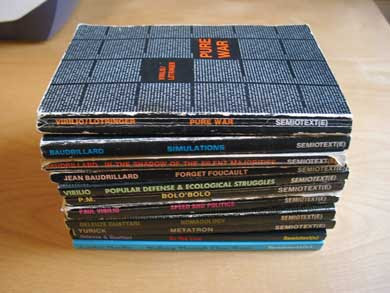
Some blurry images from my life:


Wednesday, November 14, 2007

Briefly, On Book Collection

Everyday needs a catalyst for inspiration. There is always the option to stay in bed, but waking up and engaging in something immediately -- cooking, reading, sudoku, crosswords, music -- increases the speed and intensity of one's thoughts. Activity is the active mode.

Recently, I have left the house each day with lists of things I want in my life. Because where I currently live is still sparse as far as furnishings go, I essentially set out to "furnish" my life. This isn't simply a desire to have something but more an active progression toward how I want to live in the world. This active progression never comes to an end. Rather, its destination is a utopia in itself: a mode of existing in the world that will never truly occur but is easily reducible to a possible description or image of existence. I've talked about heterotopias before, but there is a certain utility in the utopian vision of one's life that necessitates the idea of the heterotopia in the first place. As utopian conceptions intersect, you're left with being in the moment -- beautiful, tragic, sad, depressing, boring, lovely, and so on -- that is frozen outside the trajectory. It is interesting to come to terms with the notion that the way I furnish my life will never complete itself -- in some way, "feeling at home" in the world is accepting the inability to "complete" the home.

When I leave the house, I walk up Cortland Avenue to visit the bookstore. Furnishing my life with books is important as an act of collection that I find soothing. I have certain books in mind when I enter the bookstore, but I am also quite conscious of an overarching, socially inscribed value to authors and particular texts. Thus, when I move on from the bookstore to the man on the street selling books, I buy the "valued" book for a quarter.

Literally: I will never read the book. It falls in the pile of "valued" but does not overlap with my actual interests. But having it is part of the constitution of myself (which perhaps in this moment is broadcasting "fake") just as a bookshelf represents an individual's way of seeing the world. This isn't a totalized vision, but rather an interesting cross section of how one chooses to represent oneself. So, I buy books that I don't need and won't read for the purpose of having intellectual "capital", which can be freely traded using Bookmooch for books that I actually want to read and display on my bookshelf (which doesn't exist here, so all the books I've accumulated since moving to San Francisco are actually on the floor).


Just like the way I envision utopia but never realize that existence, I am always progressing toward a collection of books that will perfectly represent me. Obviously, the irony of this trajectory is that it goes to infinity, thus making my accumulation of books so excessive that representation becomes vague; the only thing conveyed is that I have too many books that I won't read. Simultaneously, the beauty of the infinite limit is that collection and "furnishing" are realized as active modes, as ways of articulating the spirit in ourselves.

Thursday, November 08, 2007

Sound Maps and an excuse for Nomadology

The recent This American Life on various forms of cartography is one of the best I’ve heard (the one on Unconditional Love, which made me cry, is also excellent). The programs covers different ways of seeing the world through maps, which are interesting because of their hyper-specific orientation in and projection of the world. The section on sound maps – the harmonies and chords produced by the objects which surround us – resonated particularly well in light of recent experience I had on the San Francisco MUNI.

The story goes:
Due to a recent “incident” that occurred on Halloween, I have changed the path I take home from work. Instead of a straight shot from work to the bus, I walk up two blocks in order to take a different route home. This detour gives me several minutes to process the events of the evening: work, coworkers, my eating habits, my plans for the evening, and so on. Eventually, I reach the bus stop and get on.

The bus is always well lit and filled with a range of different passengers. Though the ride is seemingly entirely quiet, there is a permeating feeling of tiredness and intent; most passengers, it seems, are on their way home from work, locked into a closed space with strangers who happen to share the same obscure hours as they do. We glance ever-so-briefly, play different music into our individual headsets, look at papers left by those who came before, and always thank the driver at our stops. But getting off the bus, for me, is always the most profound.

Having spent twenty or thirty minutes on the bus – which resembles a place in limbo, where time does not physically manifest but rather emerges only as a static figure on the ticker – I get off at a stop which is quite dark. In front of me, the bus pulls away, its hum serving as a final, fading reminder of the plethora of noises that accompanied my ride. These noises, I immediately realize, comforted me in some way, assuring me of companionship; even if my companions were total strangers, we all shared the same bus, all located ourselves in the precarious space that is constantly moving without visual indication of being in motion.

I step off the bus into the street. The quietness calms me. The quietness alerts me to the emptiness of my new environment, which leads more directly into solitude. There is an image, in a movie that perhaps I’ve never seen but imagined in great detail, of the bus pulling away from a deserted street. The image is the exact moment when the bus finally moves away from sight, cutting off both visual and aural indication of its presence as it rounds a nearby corner. The environmental sound changes from a hum to a low murmur, an atmospheric sound composed by thousands of sleeping, breathing bodies in the darkened homes around me (the protagonist). And though I am calm, I realize that my wakefulness means solitude at this time of night, and I have been unwillingly thrown into this position.

Instead of idling in solitude, I begin to walk up the hill, which is quite steep, and my own breathing joins the sleeping chorus. Mine is heaving, more strained, but sparks within me a sort of tired bliss as my body tries hard to forget that my feet hurt from wearing dress shoes and standing all day. As the ground levels, my footsteps suddenly seem louder than before; I’ve become accustomed to the sound of night on these blocks and my steps serve as an uplifting beat that rises louder than the sleeping, breathing murmur.

Finally I reach my door, turn the key smoothly in the lock, and step inside. In this final transition, I realize that I have moved through various sonic environments, all of which affected my general mood:

The bus was a sleepy hum; the street was the murmur of solitude; the hill was a strained, rewarding effort; the level ground was an upbeat movement; and the turning key in the lock was a smooth, clear finale.


It’s worth noting the your sonic environment – the hums and buzzes of your home and workspaces – as a tool toward further understanding your personal practices of life and your own emotional sanity. Music theory aside (I’m ignorant here), we know what sounds beautiful to our own ears and taking the sounds around us seriously can potentially open up new ways of stimulating our ways of being in the world and serving as a strategy for changing our affectations. Though I felt solitude from the deserted street, my movement into new sonic environments changed my own feelings and allowed me to process further my understanding of myself in the world.

If nothing else, let this speak toward nomadology – a specific nomadology on the sonic plane.

Monday, September 10, 2007

The Luxury of Time

I had a chance to drive from Santa Fe to Nederland, Colorado, over the weekend, making the trip up and back in two days.

(An aside: I remember what Deleuze said about the American journey vs. the French -- it's an interesting take on something (today) we wouldn't necessarily assume. The American journey is the journey into the smooth, an escape from striation.)

In preparation for the seven hour journey, I uploaded some podcasts into my ipod. Though I usually listen to music, this trip I found that for such long treks listening to conversations and lectures open up a different sort of intellectual stimulation that were more metaphysically enlightening. I had previously found some In Our Time podcasts and downloaded a couple. Now, I can't seem to download individual podcasts or archived ones. Strange.

An interesting thing about aural media in combination with driving is that there is an intermixing of disembodied philosophical speculation and the movement of one's body in space. The landscape coming down from the mountains of Colorado into New Mexico presents a vast scene that is simultaneously endless and yet free of a daunting blandness; trees and vistas poke out of the fluid, lapping waves of the ground. Such a beautiful expanse paired with the spark of philosophical banter made me realize the luxury of the moment. These moments are few due to the constant distractive jarring of our normal lives in the milieu.

It is quite an interesting place to be -- contextualized in nature around oneself yet encapsulated in a vehicle that moves quickly along the ground. A sort of hovering in the Umwelt. Though surrounded by very technology that facilitates this experience, one feels in tune with the phenomenological thread at the edge of consciousness, and perhaps reveals that plane in which the two merge and emerge into one another.

As we align ourselves into the openness, we streamline the intellectual rhizome as is bursts forth from our bodies in space: like releasing a ghosted line of fog as we go along, we insist on the creation of form through the mesh of spirit.

Tuesday, September 04, 2007

Blackle - Google and Color Inversion

From Jazzy (and Lizzy):

Blackle
(.com)


because inverted colors are more sustainable. and, occasionally, more interesting. the (.com) is the actual site.


Another trick that serves the same purpose but operates system-wide (mac os x wide) is:

ctrl + alt + apple + 8


that inverts the colors on mac os x. It isn't an extremely advanced trick, but if you're running low on battery life and/or care about saving whatever energy you can, try it out. just don't try it with blackle on, because then you're inverting the already inverted colors, which means that you're totally counteracting whatever small change you were enacting.

Sunday, August 26, 2007

From Another Space

I am posting this older blog post that was the sole entry on my old blog Autotechnomy, dated Tuesday, September 26, 2006

* * *

Finesse -- Virilio and Dance

"To me, dance is an extraordinary thing, more extraordinary than most people usually think"

--Paul Virilio


I need to outline my vision for the body's way of 'computing' technology in an attempt to set it outside of reducibility to technology. This is what I call finesse, the subtle and graceful movements of the body that can move and flow like a dance with the earth. It is a form of transcendence from the errors and misfiring that the mind can have when overwhelmed. It is conscious meditation, it is flirting, it is sex. It is the pulse you pick up on when you listen to music and can hear nothing else, the vision of god above the clouds during a sunset. It is the beautiful articulation of what it means to be inside your own body and mind.

But is it nostalgia? Finesse is what nostalgia wants to recreate. I don't rely on memories anymore. I rely on the movement of the body forward, to the experience when you start to speak and everything you say is perfect and completely coherent and everyone walks away beaming at you. It is the moment when you bring everyone to the same page in a book and learn from each other. It is, and has always been, love.

* * *

and by love, I mean spirit

Thursday, August 23, 2007

The Master Cleanse Failure

After approximately 36 hours of fasting, I had to break the fast. Failure is painful, but I have realized that my relationship with my body and with food is important and cannot merely be sidelined for an experimental fast. That is not a justification as much as it is a more a need for proper context when embarking on such a journey. I had jumped into the fast in an excited manner -- which is the way to do it on a certain level because it keeps your attitude about the fast positive -- but didn't consider that its the best part of the late summer harvest and that I wasn't actually mentally prepared to forgo food for 10 days.

I gave up early, but I ultimately have drawn an understanding of my limitations. The fast could potential be undertaken at a later point, when I've had time to think it through. Besides, the spirit is intricately intertwined with my relationship with food.