Showing posts with label memory. Show all posts

Monday, February 11, 2008

French Grammar Ghosts

From my French textbook:

"Il y a is used to state that a person, place, or thing exists. It does not necessarily mean that the item in question can be seen from where you are standing:


Dans ma chambre il y a un lit, un bureau et des chaises.

In my room, there are a bed, a desk, and some chairs. (They exist.)"


When learning a new language, the mechanics of grammar and reference reveal themselves in interesting ways. Thinking back to things I've read and the way ideas are translated into my native tongue, it is enlightening to feel the nuances of poetic texts. The words that I read shape me through their presentation, their phrasings, their quickness or slowness, their tones. But we don't remember the words of the text exactly, we are left only with senses and spirits, ghosts of the words composing our sustained reality.

I'm glad I don't have a photgraphic memory. Like these phantom poetries, I can only remember what I feel from remembrance; an impossible articulation of feeling, cyclically emerging from a point of emotion deep within recollection. From Poetics of Space:

"And all the spaces of our past moments of solitude, the spaces in which we have suffered from solitude, enjoyed, desired and compromised solitude, remain indelible within us, and precisely because the human being wants them to remain so. He knows instinctively that this space identified with his solitude is creative; that even when it is forever expunged from the present, when, henceforth, it is alien to all the promises of the future, even when we no longer have a garret, when the attic room is lost and gone, there remains the fact that we once loved a garret, once lived in an attic. We return to them in our night dreams. These retreats have the value of a shell. And when we reach the very end of the labyrinths of sleep, when we attain to the regions of deep slumber, we may perhaps experience a type of repose that is pre-human; pre-human, in this case, approaching the immemorial.

But the daydream itself, the recollection of moments confined, simple, shut-in space are the experiences of heartwarming space, of a space that does not seek to become extended, but would like above all still to be possessed. In the past, the attic may have seemed too small, it may have seemed cold in winter and hot in summer. Now, however, in memory recaptured through daydreams, it is hard to say through what syncretism the attic is at once small and large, warm and cool, always comforting."


We can never recount our dreams perfectly; people think we're mad or boring or distant from them, and writing them down leads to a forced embellishment erring on all sides. We can only emerge into dreams and out of them into the swelling feeling of a true memory, the fountainhead of a feeling. We are always only ghosts of ghosts of a memory that can never be written down, can never be spoken of.

Thursday, October 25, 2007

Brain Age (2)

Since I've been staying on a couch in the Richmond District of San Francisco, which is pretty far from the heart of the San Francisco I'm looking for, I have taken up playing Brain Age 2 on my host's Nintendo DS. The game is basically several programs that are designed to increase the functioning of certain centers of your brain; these programs are "training" for the central goal of the game: to decrease your "Brain Age" to 20 years old, which has been defined by the game as the optimum age for brain functioning. (Mine began at 50, I'm now at 36 with an all time low of 35 -- so basically I'm middle aged.)

Though I don't agree with all of the implicit claims of the game, I have been diligently working every day to decrease my brain age. Part of what is interesting about the game is that you cannot continue to play during the course of one day to improve your brain's age; you must return daily, complete the training programs, and attempt to get a better score on the Brain Age test. The test itself is a selection of several random programs, some of which are extremely hard and some of which are extremely easy, which is obviously subjective. After completing three tests your brain age is calculated, and once you've logged a brain age for the day, you can't take it back and you can't try again.

So, every morning for the past week, I wake up and play the game. Though I am trying to lower my Brain Age, what I also end up noticing is my ability to function in light of the previous night's events. This should be self evident to anyone who spends a moment in reflection, but playing the game has come to serve as a humble reminder of the connection between my mind and my body and the ways I learn and expand my mental capabilities.

I'd like to believe that playing the game has improved my ability to count, memorize, and give correct change. It certainly has improved my Sudoku skills.

Saturday, September 15, 2007

Hans Schabus, SITE Santa Fe, and installation loneliness


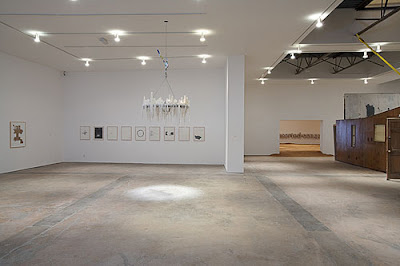
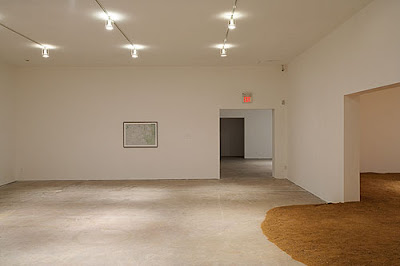
SITE Santa Fe, the contemporary art space on Santa Fe's Railyard District, commissioned an Austrian artist named Hans Schabus to take over their entire building with his meditations on the desert. From the essay accompanying the exhibition:

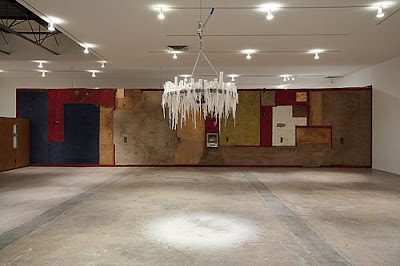
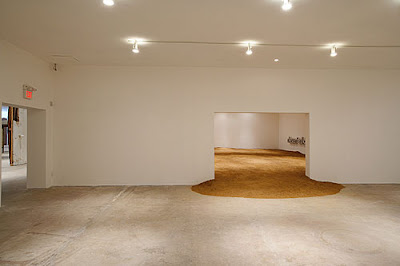
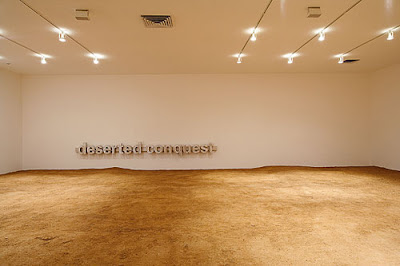
In Deserted Conquest (2007) -- an installation commissioned by SITE Santa Fe and the artist's first solo museum exhibition in the United States -- Schabus stages a series of confrontations (permanence vs. mobility; the grid vs. spiral form; artificial vs. natural; among others) within the New Mexico landscape that questions our beliefs about the desert and the American West. The objects in this exhibition -- a deconstructed mobile home, two videos, collages, over 100 tons of dirt, and an assortment of "found" items -- not only embody the oppositions that Schabus sets up, but also speak abstractly to notions of history, mythology, and alienation.

-- From the Exhibition Essay, which fails to mention an author's name.


As a whole, I enjoyed the space very much. Schabus makes huge installations out of mobile homes and the walls of old buildings, using their weathered and dilapidated aesthetics in contrast to the whiteness of the gallery space. He accents this with Cabin Fever, an interesting wagon wheel chandelier holding some two dozen candles, continuously lit and allowed to drip onto the floor over time.


In addition to these installations, Schabus takes some video footage from Yeso, NM, juxtaposing the loud, oncoming train with the dead quiet of the now ghost town. It was a stunning video that really resonated the emptiness of Yeso's spaces and the power and beauty of an oncoming train. The piece is called East, West, South, North


The title installation, Deserted Conquest is something like 10 tons of dirt packed down into a room that has its title emblazoned on the wall in steel. I imagine the space changes over time as visitors explore the empty room that is literally just full of desert dirt.


But what was most interesting, however unintended, was the fact that I was almost alone in this room. That is to say, I was actually the only patron in the entire gallery when I viewed it, but I was not the only human being. As I walked into the building, I was greeted at the desk and immediately headed into the exhibition (it was Friday, which means that there is no admission fee). I was tailed by a young woman, probably in her early twenties, who was carrying a walkie-talkie and was dressed in the casual, dark toned uniform of a SITE employee. She told me to watch my head on a specific, slightly hidden piece. This was our last direct interaction; after that, she casually milled about in whatever vicinity I was in the museum.

Now, I understand this is her job, but I felt sorry for her because she was obviously uncomfortable walking around with me but without interacting with me, basically "keeping watch" over something that hardly needed watching-over. I ended up feeling strange because I was wandering in Schabus' purposeful emptiness, an expanse that, like our romantic notions of the desert journey, seems best suited for solo exploration. Happening upon the space at the right moment allowed me such a solitary experience that was constantly disrupted by the woman guarding me throughout my viewing of Schabus' work.

Ultimately, I came to associate her presence with that of a ghost. She would not follow directly behind me, but rather wander between the rooms quickly enough to not seem like I was under constant surveillance. I instead felt like I was always vaguely being followed by something that, upon turning around, was just disappearing behind a corner.

In the end, this added to the experience Schabus sets up in his recreation of the solitude and expanse of the desert, as the ghost town of Yeso came to embody the dirt covered floor, leaving only a wispy trace of life that is always just behind you but outside of reach, outside of language, and experiencing something wholly different than you are.

Tuesday, August 07, 2007

Salads, Intensities, Rhizomes

Quite simply, a Salad Recipe that I conjured on the spot and is good enough to write down "to remember."


The individuated parts:

Snow Peas
Snap Peas
Mung and Assorted Bean Sprouts
Baby Spinach
Red Onion
Blackberries (and some juice)
Gorgonzola Cheese
Balsamic Vinegar
Celery Tahini

The construction of the whole:

I cut up the peas and the onion, one part onion to two parts peas. I threw in some bean sprouts and at that moment some fresh blackberries arrived from my backyard. I added one part blackberries (more would be fine), and placed the salad in the empty bowl in which they were picked. I added a splash of balsamic vinegar on top, then shredded some gorgonzola on top (a pretty liberal amount as its a crucial flavor). Then a dab of celery tahini, topped with a big handful of baby spinach.

Toss lightly but thoroughly, and serve.

Saturday, July 28, 2007

New Direction

Having completed my senior thesis, "Cyborgs, Posthumans, and New Techniques of Existence in the Age of Technoscience," I have found that I have less time than ever before. But soon that will all change, and I hope to expand this blog from a notebook into something more interesting and fruitful.

As the title of this blog still conveniently suggests, knowledge remains a large intellectual concern in my own thought processes; currently, I am interested in the ways in which we learn and experience the world through mediated sources as opposed to our sensorial being in the world.

My first question arises from differing practices of understanding and learning. An example comes to mind from my own life: I am trying to learn several foreign languages at the moment, as well as a computer-based language. For the cultural-linguistic languages, which are French and German (simultaneously!, or at least I'm making an attempt based on another assumption that I won't detail here), I have acquired a program called The Rosetta Stone. The Rosetta Stone is supposed to be a great, visually-oriented program that immerses the user in the language without "teaching" it in the strict sense. There are, for example, no conjugation charts or proper grammatical lessons that I have found thus far.

I still can't speak French or German, but my understanding of basic vocabulary and some elementary verbs has improved -- and improved far better than reading a beginners book on the language. The glaringly obvious problem with the program is that the immersion is one sided and digital, not heterogeneous and "actual". This is not so much a complaint as an observation -- I can't very well go to France or Germany at the moment, I understand that I'll need more language classes later, and so the program actually becomes the most progressive step toward these future endeavors because I'll have some basic understandings but no strictly formal education.

The idea here, and the one I find the most interesting, is the becoming-childlike that the language program has sparked within me; I hold to the belief that the ever-wide eyes of the child occur because it is always amazing at the surroundings and stimuli its taking in. The trick, for me, is to become-childlike in any endeavor, but with the abilities and sensibilities of someone much older. (I'm reminded of the film "Unknown White Male" at this moment that, though perhaps a hoax and surely a bit overdone, brings up this idea nicely.)

My experience with the program speaks to my understanding of experience-in-the-world as extremely important, but also the advantage of knowledge/memory (in this case, the program and its presentation of a language to be learned) that technology enables us.