Showing posts with label emptiness. Show all posts

Monday, February 04, 2008

Two Landscapes Speak

From Heart of Darkness

The great wall of vegetation, an exuberant and entangled mass of trunks, branches, leaves, boughs, festoons, motionless in the moonlight, was like a rioting invasion of soundless life, a rolling wave of plants, piled up, crested, ready to topple over the creek, to sweep every little man of us out of his little existence.


It is interesting to juxtapose this quote, which obviously describes a distinctly un-urban landscape, with the onslaught of things that modern urban life fills itself with. Things pile up, forcing themselves into every conceivable space, taking up all available terrain, just as tree limbs, vines, and creepers take over the jungle's open spaces. Heart of Darkness can surprisingly tell us something of our own modern experience: in the scramble to bask in the sun's rays, the lifeblood for the greenery of our planet, the world becomes shrouded in darkness by the sheer massiveness of the takeover; so too with urban space and the human scramble for real estate and useable space -- the world can be shadowed by buildings or consumed by "beautification" and "gentrification," leaving the few remaining spaces in a sort of darkness, but in its modern, noisily apparent form.

Friday, December 21, 2007

MUNI Drivers

There is a sign on the bus that is positioned directly behind the driver toward all of the passengers:

"Information gladly given but safety requires avoiding unnecessary conversation."


You can tell I've been reading a lot of Paul Virilio when I immediately find this sign ripe with meaning. It is incredibly telling of our disconnected present. Drivers, Who are necessarily (for now) human beings, are produced as computers -- able to communicate information but off limits as far a real, intimate connection goes. Safety is the reason given for this disconnection; it dictates that "accidents happen" when people connect, that casual conversation is "unnecessary" for the situation and should be avoided. Thus, the bus merely becomes a mode of transportation -- a very pragmatic conception -- instead of a social space where the city's inhabitants interact and coexist for several minutes a day. As mere transportation, individuals are isolated in a trajectory that simultaneously privileges and fears the accident: in order to preserve our precious, comfortable human lives in the age of technoscience, we must neutralize the spontaneous and potentially creative forces that we are capable of, silencing ourselves, locating ourselves in isolated seats, looking forward, alone.


More Virilio in a space with another purpose, which is currently unclear to me.

Thursday, November 08, 2007

Sound Maps and an excuse for Nomadology

The recent This American Life on various forms of cartography is one of the best I’ve heard (the one on Unconditional Love, which made me cry, is also excellent). The programs covers different ways of seeing the world through maps, which are interesting because of their hyper-specific orientation in and projection of the world. The section on sound maps – the harmonies and chords produced by the objects which surround us – resonated particularly well in light of recent experience I had on the San Francisco MUNI.

The story goes:
Due to a recent “incident” that occurred on Halloween, I have changed the path I take home from work. Instead of a straight shot from work to the bus, I walk up two blocks in order to take a different route home. This detour gives me several minutes to process the events of the evening: work, coworkers, my eating habits, my plans for the evening, and so on. Eventually, I reach the bus stop and get on.

The bus is always well lit and filled with a range of different passengers. Though the ride is seemingly entirely quiet, there is a permeating feeling of tiredness and intent; most passengers, it seems, are on their way home from work, locked into a closed space with strangers who happen to share the same obscure hours as they do. We glance ever-so-briefly, play different music into our individual headsets, look at papers left by those who came before, and always thank the driver at our stops. But getting off the bus, for me, is always the most profound.

Having spent twenty or thirty minutes on the bus – which resembles a place in limbo, where time does not physically manifest but rather emerges only as a static figure on the ticker – I get off at a stop which is quite dark. In front of me, the bus pulls away, its hum serving as a final, fading reminder of the plethora of noises that accompanied my ride. These noises, I immediately realize, comforted me in some way, assuring me of companionship; even if my companions were total strangers, we all shared the same bus, all located ourselves in the precarious space that is constantly moving without visual indication of being in motion.

I step off the bus into the street. The quietness calms me. The quietness alerts me to the emptiness of my new environment, which leads more directly into solitude. There is an image, in a movie that perhaps I’ve never seen but imagined in great detail, of the bus pulling away from a deserted street. The image is the exact moment when the bus finally moves away from sight, cutting off both visual and aural indication of its presence as it rounds a nearby corner. The environmental sound changes from a hum to a low murmur, an atmospheric sound composed by thousands of sleeping, breathing bodies in the darkened homes around me (the protagonist). And though I am calm, I realize that my wakefulness means solitude at this time of night, and I have been unwillingly thrown into this position.

Instead of idling in solitude, I begin to walk up the hill, which is quite steep, and my own breathing joins the sleeping chorus. Mine is heaving, more strained, but sparks within me a sort of tired bliss as my body tries hard to forget that my feet hurt from wearing dress shoes and standing all day. As the ground levels, my footsteps suddenly seem louder than before; I’ve become accustomed to the sound of night on these blocks and my steps serve as an uplifting beat that rises louder than the sleeping, breathing murmur.

Finally I reach my door, turn the key smoothly in the lock, and step inside. In this final transition, I realize that I have moved through various sonic environments, all of which affected my general mood:

The bus was a sleepy hum; the street was the murmur of solitude; the hill was a strained, rewarding effort; the level ground was an upbeat movement; and the turning key in the lock was a smooth, clear finale.


It’s worth noting the your sonic environment – the hums and buzzes of your home and workspaces – as a tool toward further understanding your personal practices of life and your own emotional sanity. Music theory aside (I’m ignorant here), we know what sounds beautiful to our own ears and taking the sounds around us seriously can potentially open up new ways of stimulating our ways of being in the world and serving as a strategy for changing our affectations. Though I felt solitude from the deserted street, my movement into new sonic environments changed my own feelings and allowed me to process further my understanding of myself in the world.

If nothing else, let this speak toward nomadology – a specific nomadology on the sonic plane.

Wednesday, October 10, 2007

Google Maps Street View

Having recently moved to San Francisco, I've found that the housing market here is not only exceedingly competitive, but quite disheartening as well. That aside (I have another blog for emotions), today I found the wonderous/daunting Google Maps Street View.

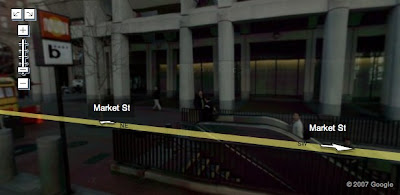
San Francisco, being the darling cultural gem in gem in geeked out Silicon Valley, is one of the cities that Google has photographed so extensively as to offer a view of houses right at their front doors. Not all of the city has been shot so far, but I assume that will come shortly. Basically, one is able to view a Google map and, in some locations, shift the perspective to the street. Not only can I see where the house that I'm visiting is located, I can get a look at the outside of the place before I even take the time to go there.

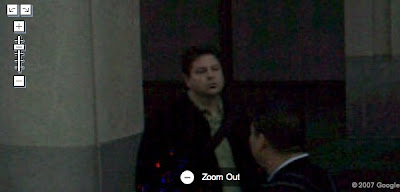
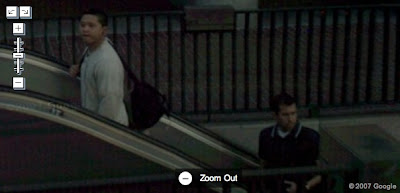
Useful? Only sort of. But a good reminder that we must, from now on, be aware of the fact that vision is becoming total; its scale is widening, becoming more precise and having more depth of field -- which itself basically gives way to another moment of vision, as in Google Maps Street View. In the web 2.0 program, you can actually see people on the street who happened to be there the moment Google took the picture. They exist like some strange ghost-like presence, perpetually tagged into the landscape for the world to see. You can make out their faces, see their boredom, their hurrying steps, or a personal smile to themselves as they walk to work.

Diving in to see people heading to work, going about their day.

The map:


View Larger Map

The street:


Upclose, forever bonded to this simulacral space:


Saturday, September 15, 2007

Hans Schabus, SITE Santa Fe, and installation loneliness


SITE Santa Fe, the contemporary art space on Santa Fe's Railyard District, commissioned an Austrian artist named Hans Schabus to take over their entire building with his meditations on the desert. From the essay accompanying the exhibition:

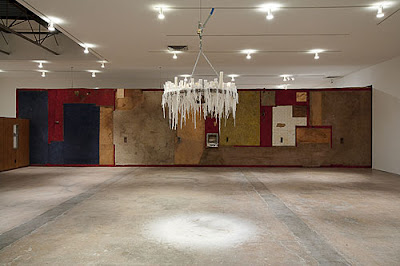
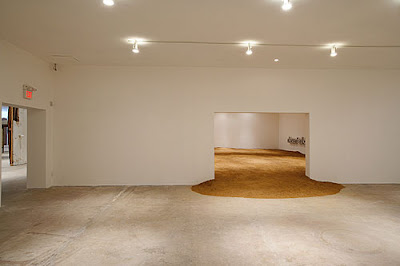
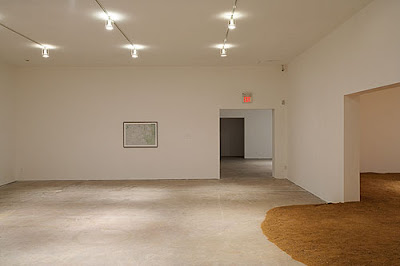
In Deserted Conquest (2007) -- an installation commissioned by SITE Santa Fe and the artist's first solo museum exhibition in the United States -- Schabus stages a series of confrontations (permanence vs. mobility; the grid vs. spiral form; artificial vs. natural; among others) within the New Mexico landscape that questions our beliefs about the desert and the American West. The objects in this exhibition -- a deconstructed mobile home, two videos, collages, over 100 tons of dirt, and an assortment of "found" items -- not only embody the oppositions that Schabus sets up, but also speak abstractly to notions of history, mythology, and alienation.

-- From the Exhibition Essay, which fails to mention an author's name.


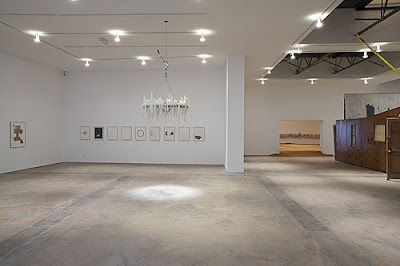
As a whole, I enjoyed the space very much. Schabus makes huge installations out of mobile homes and the walls of old buildings, using their weathered and dilapidated aesthetics in contrast to the whiteness of the gallery space. He accents this with Cabin Fever, an interesting wagon wheel chandelier holding some two dozen candles, continuously lit and allowed to drip onto the floor over time.


In addition to these installations, Schabus takes some video footage from Yeso, NM, juxtaposing the loud, oncoming train with the dead quiet of the now ghost town. It was a stunning video that really resonated the emptiness of Yeso's spaces and the power and beauty of an oncoming train. The piece is called East, West, South, North


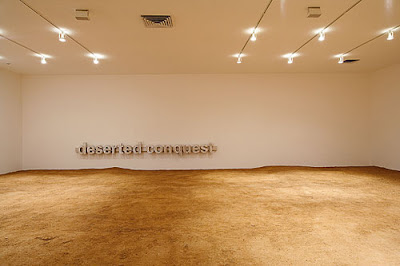
The title installation, Deserted Conquest is something like 10 tons of dirt packed down into a room that has its title emblazoned on the wall in steel. I imagine the space changes over time as visitors explore the empty room that is literally just full of desert dirt.


But what was most interesting, however unintended, was the fact that I was almost alone in this room. That is to say, I was actually the only patron in the entire gallery when I viewed it, but I was not the only human being. As I walked into the building, I was greeted at the desk and immediately headed into the exhibition (it was Friday, which means that there is no admission fee). I was tailed by a young woman, probably in her early twenties, who was carrying a walkie-talkie and was dressed in the casual, dark toned uniform of a SITE employee. She told me to watch my head on a specific, slightly hidden piece. This was our last direct interaction; after that, she casually milled about in whatever vicinity I was in the museum.

Now, I understand this is her job, but I felt sorry for her because she was obviously uncomfortable walking around with me but without interacting with me, basically "keeping watch" over something that hardly needed watching-over. I ended up feeling strange because I was wandering in Schabus' purposeful emptiness, an expanse that, like our romantic notions of the desert journey, seems best suited for solo exploration. Happening upon the space at the right moment allowed me such a solitary experience that was constantly disrupted by the woman guarding me throughout my viewing of Schabus' work.

Ultimately, I came to associate her presence with that of a ghost. She would not follow directly behind me, but rather wander between the rooms quickly enough to not seem like I was under constant surveillance. I instead felt like I was always vaguely being followed by something that, upon turning around, was just disappearing behind a corner.

In the end, this added to the experience Schabus sets up in his recreation of the solitude and expanse of the desert, as the ghost town of Yeso came to embody the dirt covered floor, leaving only a wispy trace of life that is always just behind you but outside of reach, outside of language, and experiencing something wholly different than you are.